The Case for Governance Reform in Public Housing Authorities
When a housing authority begins to struggle, the response often focuses on operational symptoms. But in many troubled housing authorities, the true issue lies one level above operations — it lies in governance.
Joaquín Cintrón Vega
Founder & Managing Principal · Velaris Advisory Partners
Introduction
Across the United States, Public Housing Authorities (PHAs) face unprecedented pressure.
They are being asked to address an affordable housing crisis of historic proportions while navigating increasing regulatory complexity, aging infrastructure, workforce shortages, rising resident expectations, and constrained federal resources.
When a housing authority begins to struggle, the response often focuses on operational symptoms:
- Low occupancy
- Poor physical condition scores
- Financial instability
- Leadership turnover
- Resident dissatisfaction
- HUD compliance findings
While these challenges are serious, they are rarely the root cause.
In many troubled housing authorities, the true issue lies one level above operations.
It lies in governance.
Governance determines how decisions are made, how accountability is enforced, how strategy is established, and how leadership is supported. When governance fails, even the most talented executive teams struggle to succeed.
Conversely, when governance is strong, organizations can recover from almost any operational challenge.
This is why governance reform represents the single most powerful intervention available to troubled PHAs seeking long-term stability and high performance.
The Hidden Cost of Governance Failure
Governance failures rarely appear in HUD inspection reports.
They do not show up directly in occupancy rates, financial statements, or capital fund expenditure reports.
Instead, they manifest through organizational behaviors:
- Constant CEO turnover
- Micromanagement by board members
- Lack of strategic direction
- Conflicting organizational priorities
- Politically driven decision-making
- Weak accountability systems
- Delayed decisions
- Low staff morale
- Public controversy and loss of trust
Over time, these symptoms create an environment where sustainable improvement becomes nearly impossible.
The organization becomes reactive rather than strategic.
The board focuses on day-to-day activities while neglecting its true responsibilities.
The CEO becomes consumed by politics rather than performance.
The result is organizational stagnation.
What High-Performing Governance Looks Like
The best housing authorities in America share a common characteristic:
Their boards understand governance.
They recognize that their role is not to manage the organization.
Their role is to govern it.
Effective Boards Focus on Five Core Responsibilities
1. Strategic Direction
Boards establish vision, mission, long-term priorities, and organizational goals. The CEO determines how to execute those priorities.
2. CEO Selection and Evaluation
Research consistently demonstrates that leadership quality is one of the strongest predictors of organizational performance. Boards must recruit effectively, evaluate objectively, support appropriately, and hold executives accountable.
3. Financial Stewardship
Strong governance requires oversight of budgets, reserves, capital investments, risk management, and long-term sustainability.
4. Policy and Compliance Oversight
Boards establish policy frameworks while ensuring organizational adherence to HUD regulations, state statutes, ethical standards, and procurement requirements.
5. Accountability to Stakeholders
Housing authorities exist to serve residents and communities. Boards serve as stewards of that public trust.
Why Traditional Governance Models Are Becoming Obsolete
Many PHA governance structures were created decades ago when housing authorities functioned primarily as property managers.
Today's housing authorities operate much differently.
Modern PHAs are often:
- Real estate developers
- Financial institutions
- Bond issuers
- Community development organizations
- Social service coordinators
- Economic development partners
Some oversee hundreds of employees, billions in assets, complex financing structures, and multi-year redevelopment initiatives.
Yet governance structures often remain unchanged.
The complexity of today's environment requires a new governance model — one focused on strategic leadership rather than administrative oversight.
The Governance Maturity Model
Governance reform should not be viewed as a one-time intervention. It should be viewed as a progression.
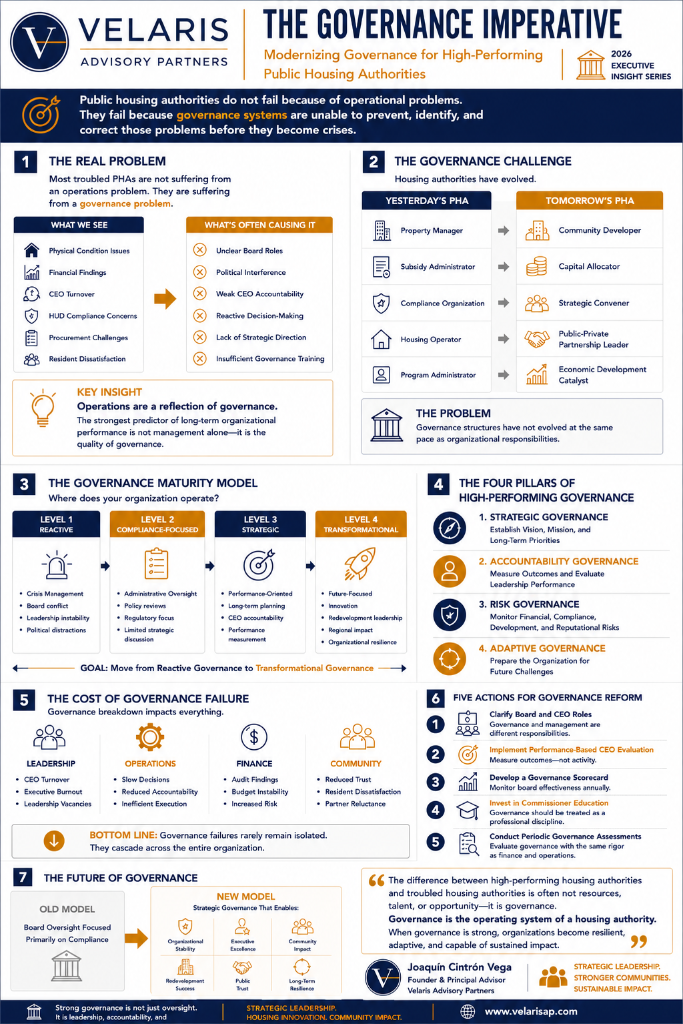
Level 1 — Reactive Governance: Crisis-driven decision-making, frequent board conflict, CEO instability, limited strategic planning.
Level 2 — Administrative Governance: Compliance-focused, policy-oriented, limited strategic engagement.
Level 3 — Strategic Governance: Long-term planning, performance measurement, effective CEO partnership, risk management.
Level 4 — Transformational Governance: Future-focused leadership, community impact orientation, innovation and adaptation, organizational resilience.
The most successful housing authorities operate at Levels 3 and 4.
Many troubled PHAs remain trapped at Levels 1 and 2.
Governance and HUD Troubled Agency Recovery
HUD interventions frequently focus on operational remediation — financial recovery plans, occupancy improvement, procurement reforms, physical asset management, and compliance corrections.
While these measures are critical, they often fail to produce sustainable improvement if governance deficiencies remain unresolved.
Without governance reform:
- New CEOs inherit old problems
- Recovery plans lose momentum
- Staff morale deteriorates
- Organizational culture remains unchanged
Governance acts as the foundation upon which all recovery efforts depend.
Without a strong foundation, operational improvements rarely endure.
The Emerging Need for Board Professionalization
One of the most significant opportunities in the industry is the professionalization of housing authority boards.
Many commissioners are appointed because of civic involvement, political affiliation, or community leadership. While these qualities are valuable, they do not automatically prepare individuals to govern complex public enterprises.
Modern board development should include training in:
- Governance fundamentals
- Fiduciary responsibilities
- Strategic planning
- Financial literacy
- Executive evaluation
- Risk oversight
- Ethics and accountability
Housing authorities invest heavily in staff training. Boards should be no different.
Governance as a Competitive Advantage
Governance is often viewed as a compliance obligation.
The highest-performing organizations view it differently.
They see governance as a strategic asset.
Strong governance enables organizations to:
- Attract exceptional executives
- Improve organizational culture
- Accelerate redevelopment initiatives
- Increase stakeholder confidence
- Strengthen community partnerships
- Navigate political environments effectively
Most importantly, it creates organizational continuity.
Leaders change. Board members rotate. Markets evolve. Governance provides stability amid change.
A Framework for Governance Reform
For PHAs seeking transformation, governance reform should focus on six priorities:
1. Clarify Board and CEO Roles — Governance and management are distinct functions. Eliminate ambiguity.
2. Establish Performance-Based CEO Evaluation — Tie evaluation systems to measurable organizational outcomes.
3. Adopt Strategic Governance Practices — Shift meeting agendas away from operational details and toward strategic issues.
4. Implement Board Development Programs — Provide ongoing commissioner education.
5. Strengthen Risk and Compliance Oversight — Create structured frameworks for monitoring organizational risk.
6. Measure Governance Effectiveness — Evaluate board performance with the same rigor applied to executive performance.
Conclusion
The affordable housing sector faces challenges that cannot be solved through operational improvements alone.
The organizations that will lead the future of affordable housing are those that recognize a fundamental truth:
Operational excellence begins with governance excellence.
Buildings can be rehabilitated. Budgets can be balanced. Policies can be rewritten.
But lasting organizational transformation occurs only when governance systems evolve.
For troubled housing authorities seeking recovery, and for high-performing agencies seeking greater impact, governance reform is not merely an administrative exercise.
It is the foundation upon which every successful transformation is built.
As housing authorities assume increasingly complex responsibilities in development, finance, community revitalization, and housing stability, governance must evolve alongside them.
The future of affordable housing depends not only on what housing authorities do — but on how they are governed.
Selected References
- U.S. Department of Housing and Urban Development (HUD) — Public Housing Agency Recovery and Sustainability guidance.
- National Association of Housing and Redevelopment Officials (NAHRO) — governance and commissioner training resources.
- Public Housing Authorities Directors Association (PHADA) — governance and executive leadership resources.
- National Center for Housing Management (NCHM) — board and executive education programs.
- Urban Land Institute — research on governance and organizational performance.
- National Association of Corporate Directors — principles of high-performing boards.