Housing Policy and Industry Trends: The Next Chapter for American Housing
The American housing conversation has fundamentally changed. Understanding these emerging trends will determine who successfully navigates the next decade — for housing authorities, developers, investors, and local governments alike.
Joaquín Cintrón Vega
Founder & Managing Principal · Velaris Advisory Partners
Introduction
The American housing conversation has fundamentally changed. What was once viewed primarily as a real estate issue has evolved into an economic competitiveness issue, a workforce issue, a public health issue, and ultimately a quality-of-life issue.
The traditional debate between affordable housing advocates and market-driven developers is increasingly giving way to a broader consensus: the United States simply does not produce enough housing to meet demand. The challenge for policymakers is no longer choosing between growth and affordability—it is designing systems that achieve both simultaneously.
For housing authorities, developers, investors, and local governments, understanding these emerging trends will determine who successfully navigates the next decade.
1. The Housing Supply Crisis Has Become Structural
Most national analyses now point toward a persistent housing deficit that has accumulated over more than a decade of underproduction.
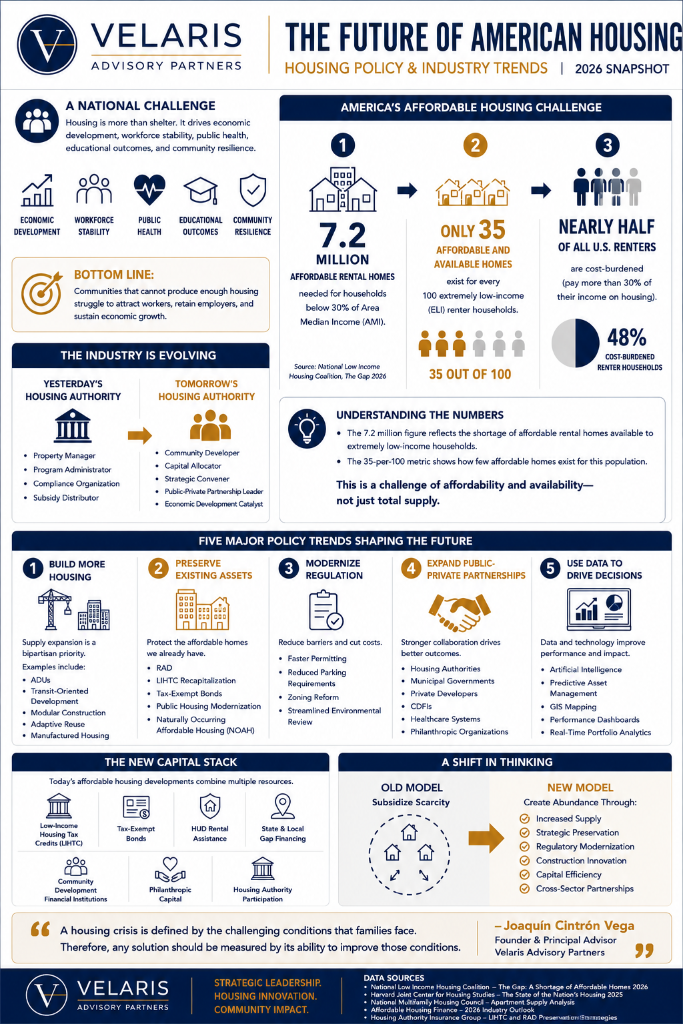
Recent estimates suggest the United States faces a housing supply gap exceeding four million homes, while extremely low-income renters face a shortage of approximately 7.2 million affordable and available rental units. Only about 35 affordable homes exist for every 100 extremely low-income renter households.
This structural imbalance produces several long-term consequences:
- Rising home prices
- Persistent rent burdens
- Delayed homeownership among younger households
- Workforce recruitment challenges for employers
- Increased pressure on public housing and Housing Choice Voucher programs
The lesson for policymakers is clear: preserving existing affordable housing is essential, but preservation alone cannot solve the crisis. Significant new production is equally necessary.
2. Housing Policy Is Becoming Bipartisan
One of the most notable developments in recent years is the emergence of bipartisan support for housing supply expansion.
States across the political spectrum have adopted reforms that reduce regulatory barriers, including:
- Legalization of accessory dwelling units (ADUs)
- Reduced parking minimums
- Transit-oriented development
- Adaptive reuse of commercial properties
- Streamlined permitting processes
- Expanded opportunities for manufactured and modular housing
At the federal level, proposals such as the 21st Century ROAD to Housing Act reflect growing recognition that outdated regulations can unnecessarily increase development costs and constrain innovation.
The emerging policy framework is shifting from:
"How do we subsidize scarcity?"
toward
"How do we remove barriers that create scarcity?"
3. Preservation Is Becoming as Important as Production
While increasing supply remains critical, the affordable housing industry increasingly recognizes that preserving existing assets often delivers the greatest return on public investment.
Across the country:
- Aging public housing portfolios require modernization
- Year-15 LIHTC properties are entering recapitalization cycles
- Naturally occurring affordable housing (NOAH) assets face acquisition pressure
- Older single-family housing stock requires substantial rehabilitation investment
Programs that combine preservation tools with modern financing structures—particularly RAD, LIHTC, and tax-exempt bonds—are becoming central components of long-term housing strategies.
Housing authorities are increasingly evolving from property managers into sophisticated asset managers and capital allocators.
4. The Affordable Housing Capital Stack Is Evolving
Affordable housing finance continues to become more complex.
Recent federal tax changes expanding the Low-Income Housing Tax Credit program and reducing the tax-exempt bond financing threshold are expected to increase development activity over time.
Modern affordable housing projects frequently combine:
- LIHTC equity
- Tax-exempt bonds
- HUD rental assistance
- Local gap financing
- Philanthropic investment
- Community development financial institutions
- Public housing authority participation
Increasingly, housing authorities themselves are acting as lenders, developers, and strategic financial partners rather than simply program administrators.
This institutional evolution represents one of the most significant transformations in the industry over the past decade.
5. Housing Authorities Are Becoming Community Development Organizations
The traditional public housing authority model focused primarily on operating housing.
The emerging model focuses on creating neighborhoods.
Modern agencies are increasingly integrating:
- Economic development
- Workforce initiatives
- Health partnerships
- Educational investments
- Commercial activation
- Climate resilience
- Mixed-income redevelopment
This shift recognizes that stable housing serves as critical infrastructure supporting broader community outcomes.
As many industry leaders now acknowledge:
Housing is economic development.
Communities that fail to produce sufficient housing increasingly struggle to attract employers, retain workers, and sustain long-term economic growth.
6. Data and Technology Will Shape the Next Generation of Policy
Housing policy is becoming increasingly data-driven.
Artificial intelligence, predictive analytics, GIS platforms, and integrated asset management systems are enabling organizations to:
- Forecast capital needs
- Optimize voucher utilization
- Improve maintenance operations
- Target investments more effectively
- Measure neighborhood outcomes
The future housing organization will not simply collect data—it will use data to make strategic decisions in real time.
Organizations that embrace operational intelligence will likely outperform those relying solely on traditional compliance frameworks.
7. The Central Challenge: Affordability Beyond Subsidy
Perhaps the most important trend is a philosophical one.
Historically, housing policy has often focused on delivering affordability through subsidy alone.
The next generation of policy increasingly seeks to deliver affordability through:
- Increased supply
- Regulatory modernization
- Construction innovation
- Public-private partnerships
- Capital market efficiency
- Strategic preservation
Subsidy remains indispensable for the nation's lowest-income households, but broader affordability requires expanding the entire housing ecosystem.
As Harvard's Joint Center for Housing Studies notes, high home prices, elevated interest rates, and record levels of cost burden continue to place extraordinary pressure on both renters and prospective homeowners.
Conclusion
The American housing crisis cannot be understood simply as a shortage of buildings.
It is fundamentally a shortage of opportunity.
Housing policy over the next decade will increasingly reward leaders who can bridge traditional divides between public and private sectors, preservation and production, affordability and economic growth.
The future belongs to organizations capable of viewing housing not as an isolated program, but as the platform upon which thriving communities are built.
A housing crisis is ultimately defined by the conditions families face. Therefore, every successful housing policy should be measured by one simple standard: Does it improve those conditions?
Bibliography
Government, Research, and Academic Sources
- Harvard Joint Center for Housing Studies – The State of the Nation's Housing 2025. Harvard University, 2025.
- Harvard Joint Center for Housing Studies – America's Rental Housing 2026. Harvard University, 2026.
- National Low Income Housing Coalition – The Gap: A Shortage of Affordable Homes 2026. NLIHC, 2026.
- National Multifamily Housing Council – Apartment Supply Shortage Analysis. NMHC.
Industry Publications
- Affordable Housing Finance – Adler Looks at the Year Ahead. December 2025.
- Affordable Housing Finance – Syndicators Enter 2026 With Cautious Optimism. February 2026.
- Affordable Housing Finance – Lending Momentum Builds for 2026. May 2026.
- PwC Emerging Trends – Multifamily Housing Outlook. 2026.
Policy and News Sources
- Reuters. "U.S. Housing Supply Gap Widens Further in 2025." March 2026.
- Business Insider. "Mamdani's Housing Plan Looks Like Other YIMBY Success Stories." May 2026.
- Barron's. "House Passes Affordable Housing Bill—With a Watered-Down Investor Ban." May 2026.
- New York Post. "Five States Made Key Legislative Changes to Reform the Housing Crisis in 2025." December 2025.
- Housing Authority Insurance Group. "LIHTC Transactions Paired With RAD: What Public Housing Authorities Need to Know." January 2026.