Why Fractional CEO Models Are Reshaping Nonprofit Leadership
For decades, nonprofit organizations operated under a simple assumption: leadership required a full-time chief executive. Today, that assumption is being challenged—and the fractional CEO model is proving to be more than a temporary solution.
Joaquín Cintrón Vega
Founder & Managing Principal · Velaris Advisory Partners
Executive Insight
For decades, nonprofit organizations and public-serving institutions operated under a simple assumption: leadership required a full-time chief executive. Today, that assumption is being challenged.
Across the country, boards of directors, housing authorities, community development organizations, healthcare nonprofits, and mission-driven institutions are increasingly adopting a new model: the Fractional CEO.
What began as a private-sector solution for startups and growth-stage companies has evolved into a strategic leadership model that allows organizations to access executive-level expertise without the financial burden or long-term commitment of a traditional CEO appointment.
For organizations facing leadership transitions, operational challenges, growth opportunities, governance issues, or resource constraints, the fractional CEO model is proving to be more than a temporary solution—it is becoming a competitive advantage.
The Leadership Crisis Facing the Nonprofit Sector
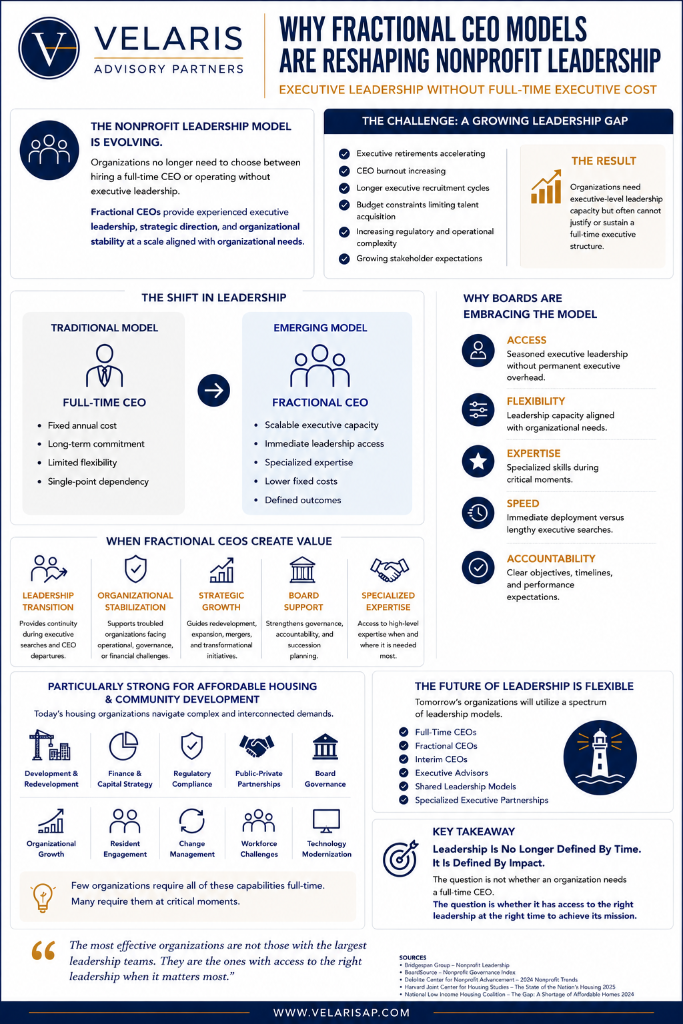
The nonprofit sector is experiencing one of the most significant leadership transitions in its history.
According to research from organizations such as the Bridgespan Group and BoardSource:
- Large numbers of executive directors and CEOs are nearing retirement.
- Leadership burnout has increased significantly since the pandemic.
- Boards are struggling to recruit experienced executive talent.
- Compensation limitations make it difficult to compete for top leaders.
- Organizations face increasing operational complexity and regulatory requirements.
The result is a widening gap between organizational needs and available leadership capacity.
Many nonprofits are discovering that they do not necessarily need a full-time CEO.
They need access to executive-level leadership.
Those are two very different things.
What Is a Fractional CEO?
A Fractional CEO is an experienced executive who serves an organization on a part-time, interim, or contract basis while providing strategic leadership, executive oversight, and organizational guidance.
Unlike consultants who advise from the sidelines, fractional CEOs operate as active leaders.
They often:
- Report directly to the Board
- Lead executive teams
- Oversee strategic initiatives
- Manage organizational risk
- Support fundraising and stakeholder engagement
- Guide operational transformation
- Lead crisis stabilization efforts
In many cases, organizations gain access to executives with decades of leadership experience at a fraction of the cost of a permanent executive hire.
Why Boards Are Embracing the Model
Leading advisory firms consistently observe that boards are becoming more focused on outcomes than organizational traditions.
The key question is no longer:
"Do we need a full-time CEO?"
The more strategic question is:
"What leadership capacity do we need to achieve our objectives?"
Fractional CEOs allow boards to align leadership investment with organizational realities.
Common Situations Where Fractional CEOs Create Value
Leadership Vacancies
Executive departures can create uncertainty and operational disruption. A fractional CEO provides immediate stability while allowing boards to conduct thoughtful executive searches rather than rushing into permanent hiring decisions.
Organizational Turnarounds
When organizations face financial, governance, compliance, or operational challenges, boards often need highly specialized leadership experience for a defined period. Fractional CEOs can lead stabilization efforts without creating long-term executive overhead.
Strategic Growth
Organizations entering redevelopment projects, expansion initiatives, mergers, or transformational change efforts may require executive capacity that exceeds their existing leadership structure. Fractional leadership provides temporary executive horsepower during periods of accelerated growth.
Early-Stage Organizations
Many nonprofit startups and emerging organizations simply cannot justify a six-figure executive salary. A fractional model provides access to experienced leadership during formative years while preserving resources for mission delivery.
The Economics of Executive Leadership
One of the strongest drivers behind the growth of fractional leadership is economics.
A traditional nonprofit CEO may require:
- Base salary
- Benefits
- Retirement contributions
- Executive recruiting costs
- Professional development
- Potential severance obligations
Total annual executive costs frequently exceed $250,000–$400,000 for mid-sized organizations and substantially more for larger institutions.
A fractional CEO arrangement often provides access to senior leadership expertise for a fraction of that investment.
More importantly, organizations only purchase the executive capacity they actually need.
This creates greater financial flexibility while maintaining strategic leadership continuity.
The Public Housing and Affordable Housing Opportunity
Few sectors are better positioned to benefit from fractional executive leadership than affordable housing.
Housing authorities, nonprofit housing providers, and community development organizations are facing unprecedented complexity.
Today's leaders must navigate:
- Federal compliance requirements
- Capital planning
- Real estate development
- Public-private partnerships
- Financial restructuring
- Board governance
- Resident engagement
- Workforce challenges
- Technology modernization
- Political stakeholder management
Finding a single executive with expertise across all these disciplines is increasingly difficult.
A fractional CEO model provides access to highly specialized leadership during periods of transition, redevelopment, repositioning, or organizational transformation.
For smaller housing authorities in particular, the model can provide executive expertise that would otherwise be financially unattainable.
Governance Advantages Often Overlooked
The most successful boards understand that governance and management are distinct responsibilities.
Fractional CEOs can actually strengthen governance because their role is often tied to clearly defined objectives, timelines, and performance expectations.
Benefits frequently include:
- Greater board accountability
- Clear performance metrics
- Defined engagement periods
- Strategic focus
- Improved succession planning
- Reduced organizational dependency on a single individual
Organizations become less vulnerable to leadership disruptions and more resilient over time.
The Future of Nonprofit Leadership
The rise of fractional leadership reflects a broader shift occurring across every sector of the economy.
Organizations increasingly seek:
- Specialized expertise
- Flexibility
- Scalability
- Lower fixed costs
- Faster access to talent
- Outcome-based leadership
Nonprofits are no exception.
As boards become more sophisticated and operational environments become more complex, the traditional "one-size-fits-all" executive model will continue to evolve.
The future will likely include a spectrum of leadership structures:
- Full-time CEOs
- Fractional CEOs
- Interim CEOs
- Executive advisory partnerships
- Shared leadership models
- Hybrid executive teams
The organizations that thrive will be those willing to align leadership structures with mission requirements rather than historical assumptions.
Key Takeaway
The emergence of fractional CEOs is not a reflection of weakened leadership.
It is evidence of leadership becoming more adaptive.
For nonprofits and public-serving organizations, the question is no longer whether leadership must be full-time.
The question is whether the organization has access to the right leadership, at the right time, for the right purpose.
Boards that answer that question strategically will be better positioned to navigate uncertainty, accelerate performance, and advance mission impact in an increasingly complex environment.
About the Author
Joaquín Cintrón Vega is Founder & Principal Advisor of Velaris Advisory Partners, specializing in executive leadership, fractional CEO services, board governance, organizational transformation, operational excellence, and affordable housing strategy. With more than 25 years of executive leadership experience, he advises boards, CEOs, housing authorities, and mission-driven organizations navigating growth, transition, and complex organizational challenges.