Building Resilient Communities Through Inclusive Development
How community development organizations can leverage governance excellence and strategic partnerships to create lasting impact.
Joaquín Cintrón Vega
Founder & Managing Principal · Velaris Advisory Partners
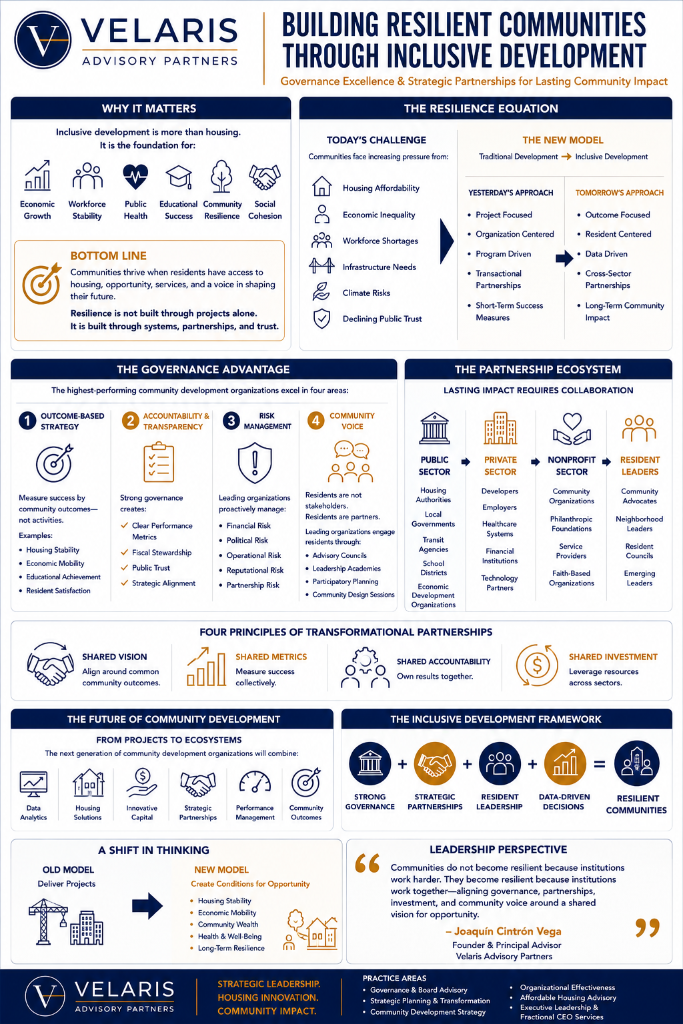
How Community Development Organizations Can Leverage Governance Excellence and Strategic Partnerships to Create Lasting Impact
Executive Summary
Across the United States, community development organizations are being asked to solve increasingly complex challenges: housing affordability, economic mobility, neighborhood revitalization, workforce development, climate resilience, and public trust.
Yet many organizations continue to approach these challenges through fragmented programs, siloed partnerships, and short-term funding strategies.
The most successful organizations have adopted a different model.
They recognize that resilient communities are not built solely through development projects. They are built through governance excellence, strategic collaboration, and a long-term commitment to inclusive growth.
Organizations that align leadership, stakeholders, capital, and community voice consistently outperform those that focus exclusively on project delivery.
The question is no longer whether community development should be inclusive.
The question is whether organizations possess the governance and partnership frameworks necessary to sustain inclusion over time.
The New Definition of Community Resilience
Historically, resilience was measured by an organization's ability to recover from disruption.
Today, resilience means something far more comprehensive:
- Economic resilience
- Housing stability
- Social cohesion
- Institutional trust
- Environmental sustainability
- Access to opportunity
Communities that perform well in these areas share one common characteristic:
They have institutions capable of coordinating across sectors and maintaining strategic focus despite changing political, economic, and social conditions.
In other words:
Strong communities require strong governance.
Why Inclusive Development Matters More Than Ever
Inclusive development is not simply a social objective.
It is an economic strategy.
Research consistently demonstrates that regions with greater economic inclusion experience:
- Stronger long-term growth
- Higher labor force participation
- Greater entrepreneurial activity
- Improved educational outcomes
- Lower social service costs
- Greater resilience during economic downturns
When residents have access to stable housing, transportation, healthcare, education, and employment opportunities, communities become more competitive and sustainable.
The challenge is that inclusion rarely happens organically.
It must be intentionally designed into policies, investments, and development strategies.
Governance: The Foundation of Sustainable Impact
Many community development initiatives struggle not because of inadequate funding, but because of inadequate governance.
High-performing organizations understand that governance extends far beyond compliance.
It provides the framework for:
Strategic Direction
Boards and executive leaders must establish clear priorities aligned with community outcomes rather than organizational activities.
The most effective organizations measure success by impact, not effort.
Accountability
Strong governance creates transparency around:
- Performance metrics
- Financial stewardship
- Community engagement
- Equity outcomes
- Strategic initiatives
This accountability strengthens credibility with funders, residents, and policymakers.
Risk Management
As development projects become larger and more complex, organizations must proactively manage:
- Financial risk
- Political risk
- Reputational risk
- Operational risk
- Partnership risk
Organizations with mature governance structures are better positioned to navigate uncertainty while maintaining mission focus.
The Strategic Partnership Imperative
No single organization can solve systemic community challenges alone.
The most successful community development initiatives increasingly rely on ecosystem-based partnerships.
These partnerships typically include:
Public Sector Partners
Local governments, housing authorities, school districts, transit agencies, and economic development organizations provide critical policy alignment and public investment.
Private Sector Partners
Developers, employers, healthcare systems, financial institutions, and technology firms contribute capital, expertise, and market-based solutions.
Nonprofit Organizations
Community-based organizations provide local knowledge, trusted relationships, and direct service capacity.
Residents
Residents are not stakeholders to be consulted after decisions are made.
They are co-creators of community outcomes.
Organizations that authentically engage residents throughout planning and implementation consistently achieve stronger and more sustainable results.
Moving Beyond Transactions to Transformational Partnerships
Many partnerships remain transactional.
Organizations collaborate around funding opportunities but operate independently once resources are secured.
Transformational partnerships operate differently.
They align around:
Shared Vision
Partners establish a common understanding of desired outcomes and community priorities.
Shared Metrics
Success is measured collectively rather than through individual organizational achievements.
Shared Accountability
Partners jointly own outcomes and continuously adapt strategies based on performance data.
Shared Investment
Resources, expertise, and influence are leveraged across institutions to maximize impact.
This model creates significantly greater value than isolated initiatives.
Four Governance Practices of High-Performing Community Development Organizations
1. Outcome-Based Strategic Planning
Leading organizations shift away from activity-based planning and focus on measurable community outcomes.
Instead of asking: "What projects should we complete?"
They ask: "What conditions should improve for residents?"
This shift fundamentally changes investment decisions and organizational priorities.
2. Data-Driven Decision Making
Modern community development requires robust performance measurement systems.
Organizations should routinely monitor:
- Housing stability
- Resident income growth
- Educational attainment
- Workforce participation
- Public safety indicators
- Community satisfaction
Data transforms governance discussions from opinion-based conversations into evidence-based decision making.
3. Continuous Community Engagement
Engagement cannot be limited to public hearings and surveys.
Leading organizations create ongoing mechanisms for resident participation through:
- Advisory councils
- Resident leadership programs
- Participatory planning processes
- Community design workshops
- Digital engagement platforms
Trust becomes a strategic asset.
4. Cross-Sector Leadership Development
Sustainable impact requires leadership pipelines that extend beyond a single organization.
Investing in future leaders across sectors strengthens regional capacity and improves long-term collaboration.
The strongest communities intentionally develop leaders who can operate across institutional boundaries.
The Affordable Housing Connection
Housing often serves as the foundation upon which inclusive development is built.
Affordable housing developments are increasingly evolving into broader community platforms that integrate:
- Workforce development
- Healthcare access
- Early childhood education
- Small business support
- Financial empowerment services
- Community gathering spaces
This evolution reflects a growing recognition that housing stability and economic mobility are interconnected.
The most impactful developments are no longer simply places to live.
They are engines of community transformation.
Looking Ahead: The Next Generation of Community Development
The future of community development will be shaped by organizations capable of integrating:
- Governance excellence
- Strategic partnerships
- Resident leadership
- Data analytics
- Innovative financing
- Long-term stewardship
As communities face increasing economic, demographic, and environmental pressures, organizations must move beyond project-centric thinking and embrace systems-level leadership.
The winners will not be those that build the most projects.
They will be those that build the strongest ecosystems.
Key Takeaways for Community Development Leaders
- Governance is a strategic asset, not an administrative requirement.
- Inclusive development is both a social and economic imperative.
- Long-term impact requires cross-sector collaboration.
- Residents must be treated as partners, not participants.
- Data-driven accountability strengthens trust and performance.
- Resilient communities emerge when organizations align around shared outcomes.
Closing Perspective
The most successful community development organizations understand a fundamental truth:
Communities thrive when institutions work together with purpose, accountability, and a shared commitment to opportunity.
Buildings can transform a neighborhood.
Programs can improve lives.
But sustainable prosperity emerges when governance, partnerships, and community voice come together to create systems capable of delivering opportunity for generations.
That is the essence of resilient communities.
And it is the future of inclusive development.
About Velaris Advisory Partners
Velaris Advisory Partners helps housing authorities, community development organizations, local governments, and mission-driven institutions strengthen governance, improve operational performance, and execute transformational initiatives that deliver measurable community impact. Through executive advisory services, strategic planning, operational excellence, governance consulting, and organizational transformation support, Velaris partners with leaders committed to building stronger organizations and more resilient communities.