The Governance Imperative: Why Boards Define Organizational Destiny
Governance is no longer an administrative function. It is the single greatest determinant of whether an organization thrives, stagnates, or fails. For boards of housing authorities and mission-driven institutions, the imperative has never been clearer.
Joaquín Cintrón Vega
Founder & Managing Principal · Velaris Advisory Partners
Executive Summary
Governance is no longer an administrative function.
It is the single greatest determinant of whether an organization thrives, stagnates, or fails.
Across public housing authorities, nonprofit organizations, and mission-driven institutions, the organizations that consistently deliver on their missions share one characteristic: disciplined, strategic, courageous governance.
The organizations that struggle almost always trace their decline to governance failures long before operational failures appear.
For boards, the imperative has never been clearer.
The quality of an organization will never exceed the quality of its governance.
The Governance Imperative
For decades, governance was treated as a compliance obligation.
Boards convened, reviewed reports, approved motions, and adjourned.
That model is no longer sufficient.
Today, governance is a strategic discipline that determines:
- Strategic direction
- Executive accountability
- Enterprise risk management
- Leadership continuity
- Organizational performance
- Community trust
Boards that continue to treat governance as a formality will find themselves managing crises rather than shaping futures.
Boards that elevate governance as a strategic function become the architects of organizational success.
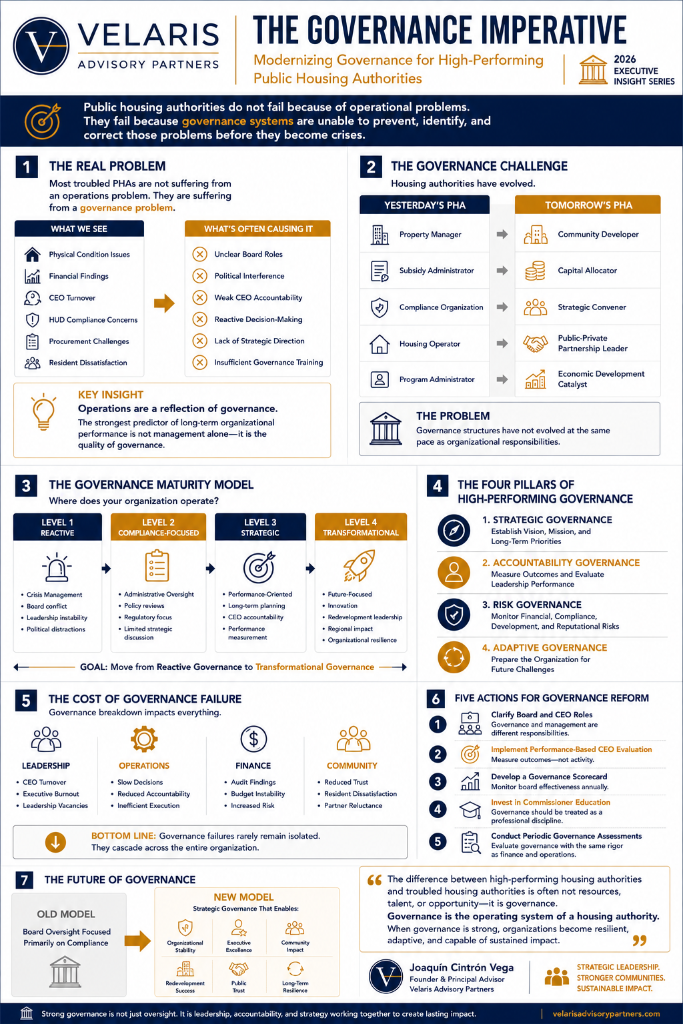
Four Pillars of Effective Governance
1. Strategic Direction
The foremost responsibility of a board is to define where the organization is going.
High-performing boards establish clear strategic priorities aligned with community outcomes rather than organizational activities.
They ask not what the organization should do, but what conditions should improve for the people it serves.
This distinction separates organizations that stay busy from organizations that create impact.
2. Accountability
Accountability is the mechanism through which strategy becomes execution.
Effective boards establish clear performance expectations for executive leadership and measure progress against measurable outcomes.
They do not manage the CEO. They hold the CEO accountable.
This requires:
- Documented performance objectives
- Regular progress reviews
- Transparent reporting
- Constructive challenge
- Consequences for sustained underperformance
Without accountability, strategy dissolves into intention.
3. Risk Oversight
Modern boards are expected to understand the full spectrum of enterprise risk.
- Financial risk
- Regulatory and compliance risk
- Operational risk
- Reputational risk
- Cybersecurity risk
- Political risk
- Partnership risk
High-performing boards routinely review enterprise risk dashboards and ensure mitigation strategies are in place.
They recognize that risk oversight is not about avoiding risk entirely. It is about ensuring the organization takes the right risks deliberately and manages them actively.
4. Leadership Continuity
Leadership instability is one of the most common precursors to organizational decline.
Repeated executive turnover produces drift, erodes staff confidence, and undermines strategic momentum.
Boards must own leadership continuity as a governance responsibility, not merely a human resources function.
This means maintaining formal plans for:
- Emergency succession
- Interim leadership
- Long-term executive transition
- Executive development and coaching
Organizations that prepare for leadership transitions before they occur navigate them with stability. Those that do not are destabilized by them.
Why Governance Failures Precede Operational Failures
One of the most consistent patterns observed across troubled organizations is that operational failures rarely begin as operational problems.
Most begin as governance problems.
Board micromanagement creates confusion, undermines executive authority, and slows decision-making.
Absence of accountability allows performance issues to persist until they become crises.
Leadership instability produces organizational drift and staff disengagement.
Weak strategic direction leaves organizations reactive rather than proactive.
Limited risk awareness allows systemic threats to grow unaddressed.
When organizations fail, the root cause is almost always found in the boardroom long before it appears in the financial statements.
The Difference Between Governing and Managing
The most common governance failure is the collapse of the boundary between governance and management.
Boards that manage become entangled in operations, lose strategic perspective, and undermine the very executives they are meant to hold accountable.
Effective boards govern.
They focus on:
- Vision and strategy
- Executive performance
- Enterprise risk
- Financial stewardship
- Organizational outcomes
They leave operations to management.
This discipline is not passivity. It is the highest form of leadership.
The Characteristics of High-Performing Boards
Across the most effective governing boards, several characteristics consistently emerge.
They govern strategically. Their time is spent on direction, accountability, and risk rather than administrative detail.
They use data. Performance discussions are grounded in measurable outcomes, not opinion.
They invest in governance development. Board education is treated as essential infrastructure.
They challenge constructively. They ask difficult questions while maintaining trust with executive leadership.
They think beyond compliance. Their objective is organizational excellence, not the avoidance of findings.
They plan for continuity. They prepare for leadership transitions before they become necessary.
Five Questions Every Board Should Ask
-
Are we governing strategically, or are we reacting operationally?
-
Do we understand our organization's greatest risks?
-
Is our executive evaluation process tied to organizational outcomes?
-
Do we have a documented succession plan?
-
Could we demonstrate strong governance if examined tomorrow?
The answers to these questions reveal vulnerabilities long before they become crises.
The Strategic Advantage of Strong Governance
In an environment of increasing complexity, funding constraints, and public accountability, governance quality becomes a competitive advantage.
Organizations with strong boards are better positioned to:
- Secure funding and investment
- Attract and retain executive talent
- Deliver complex redevelopment initiatives
- Navigate regulatory change
- Maintain community trust
- Sustain performance over time
Those without strong governance structures face increasing challenges regardless of their operational resources.
Closing Perspective
The governance imperative is not a warning.
It is an opportunity.
Organizations that elevate governance as a strategic discipline position themselves for lasting impact. Those that treat it as a formality will eventually be governed by the consequences of their neglect.
For boards willing to lead, the path is clear.
Define direction. Enforce accountability. Understand risk. Ensure continuity.
Govern well, and the organization will follow.