Strategic Planning That Actually Works: Beyond the Binder on the Shelf
Organizations often spend 80% of their effort developing strategy and only 20% planning implementation. High-performing organizations reverse that equation.
Joaquín Cintrón Vega
Founder & Managing Principal · Velaris Advisory Partners
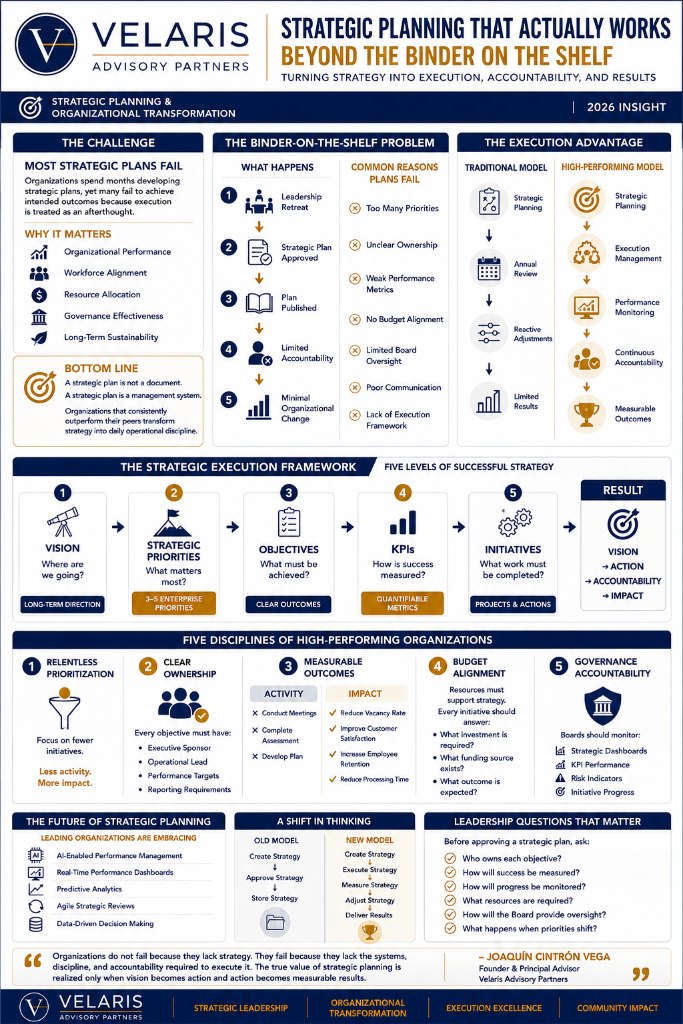
Organizations often spend 80% of their effort developing strategy and only 20% planning implementation.
High-performing organizations reverse that equation.
The Binder-on-the-Shelf Syndrome
National advisory firms frequently encounter organizations with strategic plans containing:
- Vision statements
- Mission statements
- Strategic pillars
- Objectives
- Action items
Yet when asked:
"Who owns this initiative?"
The answer is unclear.
When asked:
"How is progress measured?"
The metrics are vague.
When asked:
"How does the Board monitor implementation?"
There is no structured process.
Without ownership, measurement, and governance, strategic plans become aspirational documents rather than operational tools.
What Successful Organizations Do Differently
The most effective organizations view strategic planning as a continuous cycle rather than a one-time event.
They focus on five core principles.
1. Relentless Prioritization
Many organizations attempt to pursue 20 to 30 major initiatives simultaneously.
This creates organizational exhaustion.
Successful organizations typically focus on:
- 3–5 strategic priorities
- 10–15 enterprise initiatives
- A limited number of measurable outcomes
Less becomes more.
Clarity creates momentum.
2. Clear Ownership
Every strategic objective should have:
- Executive Sponsor
- Operational Lead
- Defined deliverables
- Performance targets
- Reporting cadence
If everyone owns something, nobody owns it.
Accountability requires names, not departments.
3. Measurable Outcomes
Organizations frequently measure activity rather than impact.
Examples of weak metrics:
- Conduct stakeholder meetings
- Complete assessment
- Develop implementation plan
Examples of outcome-focused metrics:
- Reduce vacancy rate by 15%
- Increase customer satisfaction by 20%
- Reduce processing time by 30%
- Improve employee retention by 10%
Execution begins when outcomes become measurable.
4. Integration with Budgeting
One of the most common strategic planning mistakes is treating budgeting and planning as separate exercises.
Every strategic priority should answer:
- What resources are required?
- What investments are necessary?
- What funding source exists?
- What return is expected?
Organizations that fail to align strategy and budget inevitably underfund their priorities.
5. Governance and Oversight
High-performing Boards understand that governance does not end when the strategic plan is approved.
Governance begins at approval.
Effective Boards receive:
- Quarterly strategy dashboards
- Performance scorecards
- Risk assessments
- Strategic initiative updates
- Accountability reviews
The Board's role is to ensure organizational focus remains aligned with adopted priorities.
The Strategic Execution Framework
Leading advisory firms increasingly utilize integrated execution frameworks that connect vision to measurable results.
The framework consists of five levels.
Level 1: Vision
Where are we going?
A compelling vision provides long-term direction.
Example: "To become the nation's leading housing authority in resident outcomes and community transformation."
Level 2: Strategic Priorities
What matters most?
- Financial Sustainability
- Resident Success
- Housing Preservation
- Workforce Excellence
- Innovation & Technology
Level 3: Strategic Objectives
What must be achieved?
- Improve operational efficiency
- Expand affordable housing supply
- Increase resident economic mobility
Level 4: Key Performance Indicators (KPIs)
How will success be measured?
- Occupancy rate
- Unit turnaround time
- Employee engagement score
- Development pipeline growth
- Customer satisfaction metrics
Level 5: Initiatives
What specific work must be completed?
- ERP modernization
- Process redesign
- Workforce development program
- Asset management transformation
This structure creates a direct line between vision and daily operations.
Why Strategy Must Become an Operating System
The most successful organizations do not treat strategic planning as an annual exercise.
Instead, they embed strategy into:
Leadership Meetings
Every executive meeting should address:
- Progress on strategic initiatives
- Emerging risks
- Resource allocation
- Performance metrics
Performance Management
Employee goals should align with strategic priorities. When strategy is disconnected from performance evaluations, execution suffers.
Budget Development
Capital and operating budgets should support strategic priorities. Strategy should drive spending—not the reverse.
Board Reporting
Board agendas should consistently include strategic performance updates. The Board cannot govern what it cannot measure.
The Public Sector and Housing Authority Challenge
For public agencies and housing authorities, strategic execution is even more critical.
The environment includes:
- Funding uncertainty
- Regulatory complexity
- Political scrutiny
- Resident expectations
- Workforce challenges
- Aging infrastructure
In this environment, strategic plans must become decision-making tools.
The most successful agencies utilize strategic plans to:
- Prioritize capital investments
- Guide redevelopment initiatives
- Align Board and executive leadership
- Improve resident outcomes
- Strengthen organizational resilience
The agencies making the greatest impact today are not necessarily those with the most ambitious plans.
They are the agencies with the strongest execution disciplines.
The Future of Strategic Planning
Strategic planning is evolving rapidly.
Leading organizations are increasingly incorporating:
Real-Time Performance Dashboards
Replacing annual reporting cycles with continuous monitoring.
Data-Driven Decision Making
Using predictive analytics to identify trends before problems emerge.
AI-Enabled Performance Management
Leveraging artificial intelligence to monitor progress, identify bottlenecks, and forecast outcomes.
Agile Strategy Reviews
Moving from static five-year plans to dynamic strategic management systems.
The future belongs to organizations that can adapt quickly while maintaining strategic discipline.
Key Questions Every Leadership Team Should Ask
Before approving the next strategic plan, leadership teams should ask:
- Who owns each objective?
- How will success be measured?
- What resources are required?
- How will progress be monitored?
- What role will the Board play in oversight?
- How often will strategy be reviewed?
- What happens when priorities change?
If these questions cannot be answered clearly, execution risk remains high.
Closing Perspective
The purpose of strategic planning is not to create a document.
The purpose of strategic planning is to create organizational alignment, accountability, and measurable results.
The organizations that consistently outperform their peers understand that strategy is not a retreat, a workshop, or a binder on a shelf.
It is a disciplined management system that connects vision to execution.
The difference between organizations that merely plan and organizations that transform is not the quality of their ideas.
It is their ability to execute them.
In an era defined by disruption, complexity, and accelerating change, execution has become the ultimate competitive advantage.
About Velaris Advisory Partners
Velaris Advisory Partners helps public sector organizations, housing authorities, boards, and executive leaders transform strategy into measurable results through strategic planning, governance excellence, operational transformation, performance management, and execution-focused advisory services.
Because the best strategic plans are not the ones that look impressive in a board packet—they are the ones that change outcomes.